Heavy haul and specialized transport
Wide, tall and heavy loads by road. Permits, escorts and line lifts are on us.
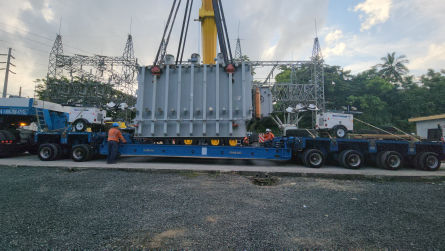
The permit sets the date, not the truck
On an oversize move, the trailer is the easy part. The paperwork and the road decide when the piece can roll.
Every state, province and country on the route issues its own permit, with its own limits on width, height, weight, escorts and travel hours. Some will not issue until an engineer has checked the bridges. Some allow oversize loads only in daylight, or keep them off the road at rush hour. A low line or a weak culvert on the obvious road can force a detour, and the detour can add a jurisdiction. That is why the clock on a heavy haul starts with the purchase order, not with the delivery date.
- Heavy hauls completed by the team: more than 200
- Heaviest single piece: a 550,000 lb transformer
- Combined experience: more than 100 years
These figures belong to the people who run our moves. The team earned them under a different company.
From purchase order to the gate
One coordinator prices the haul, walks the route, files the permits and reports to you at every hand-off.
Measure the piece
Weight, length, width, height, center of gravity and lifting points decide the trailer and the number of axle lines. Rough figures start the quote; drawings finish it.
Engineer the route
Clearances, bridge ratings, culverts, turning room, overhead lines and both gates are checked before any permit is filed.
File the permits
Each jurisdiction gets its own application, sequenced so the approvals arrive together.
Book escorts and line lifts
Pilot cars, police escorts and utility crews are booked to the hour of the permitted travel window.
Roll
Partner trailers matched to the piece carry it inside the window, to the gate or onto its foundation.
Bridges, culverts and corners are engineered first
A heavy load spreads its weight across axle lines, and every bridge, culvert and buried pipe on the route has to carry what lands on it. Where a structure is close to its rating, an engineer checks it. The answer may be a different axle spacing, a slower crossing, a plate over a culvert or another road.
The survey walks the corners too. A long trailer needs swept-path room at every turn, and the gate at each end has to open wide enough for the load, not just the tractor.
Part of that engineering we do ourselves. On most routes we bring in engineers from the country the load travels through.
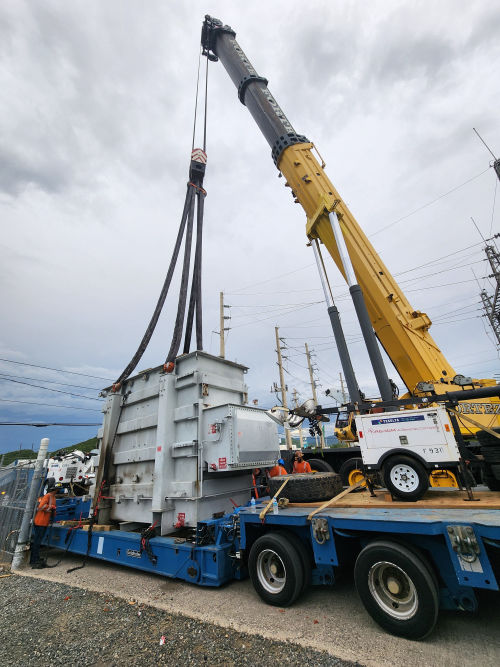
Escorts and line lifts, state by state and country by country
Escort rules change at every border. One state wants a pilot car ahead of a wide load, the next wants one front and rear, and a city may want police through its streets. Outside the United States the agencies change, and so do the rules.
Overhead lines are the other hard limit. When a tall load cannot pass under a line, the utility that owns it raises it or takes it out of service for the hours the load needs. That is a line lift, and it has to match the permitted window to the hour. Many heavy hauls run at night for that reason: the road is quiet enough for the escorts and the utility crews to work the load through together.
We arrange the escorts and the line lifts along with the insurance, the route planning and the equipment scheduling. You do not call the agencies or the utilities.
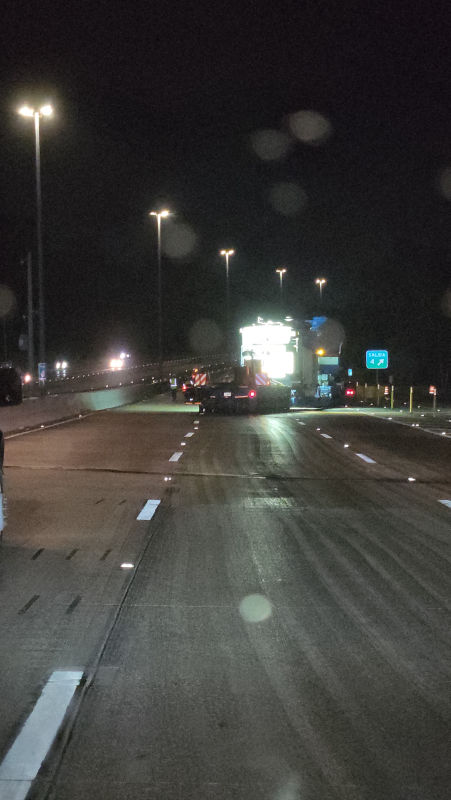
When the plan meets the road
Every heavy haul has a day when something moves. These are the usual ones, and what happens next.
The permit window slips
Escorts and the utility crew are booked to the permitted window, so a new window means booking them again. We arrange both and send you the new date.
The line crew is late
The load waits for the line. Line lifts are arranged with the utility as part of the route plan, and the move goes when the line is up.
Weather closes the road
Many permits limit travel in high wind or poor visibility. When the weather shuts the window, the move waits and we rearrange the escorts around the next one.
The date moves up
Shipping is usually the last thing a project plans, and the date arrives sooner than anyone expected. We answer quickly and mobilize crews fast, so a late call still gets a real plan.
What goes on the trailer
Power and energy equipment
- Power and substation transformers
- Switchgear and control equipment
- Gas turbines and power plant equipment
- Wind turbine components
- Electrical equipment for data centers
Containers and difficult cargo
- Over-dimensional and overweight industrial pieces
- Containers that need special handling
- Cargo that is fragile, awkward or on a tight date
Moving something this size? Tell us what it weighs, how big it is and where it has to go.
Permits, escorts and timing
What makes a load oversize or overweight?
Any load wider, taller, longer or heavier than the legal limit for a standard truck on that road. The limits differ by state and by country, and so do the permits, the escorts and the hours the load may travel.
How early should we call?
When the purchase order is placed. Permits and route surveys can take longer than the haul itself. If the date is already close, call anyway; a short notice changes the plan.
What do you need to price a haul?
The weight and the dimensions, the origin and the destination, and the date the piece has to arrive. Drawings, lifting points and photos of both sites help, and they can follow.
Who does the bridge and route engineering?
Our own engineers take some of it. Most of it goes to engineers hired in that country, because the structures, the ratings and the agencies are local too.
Who arranges the police escorts and the line lifts?
We do. The permits, the pilot cars, the police escorts and the work with each utility come to you as one schedule.
Can the haul start at a port?
Yes. The discharge, the port yard and the road leg are planned together, as one move.
Do you set the piece on its foundation, or only deliver it?
Both. Delivery to the gate is one option. Setting it on the pad by gantry, jack and slide or crane is the other.
Send us the piece and the route
Tell us the weight and dimensions, where it sits today and where it must be delivered. The permits are the first thing we look at.