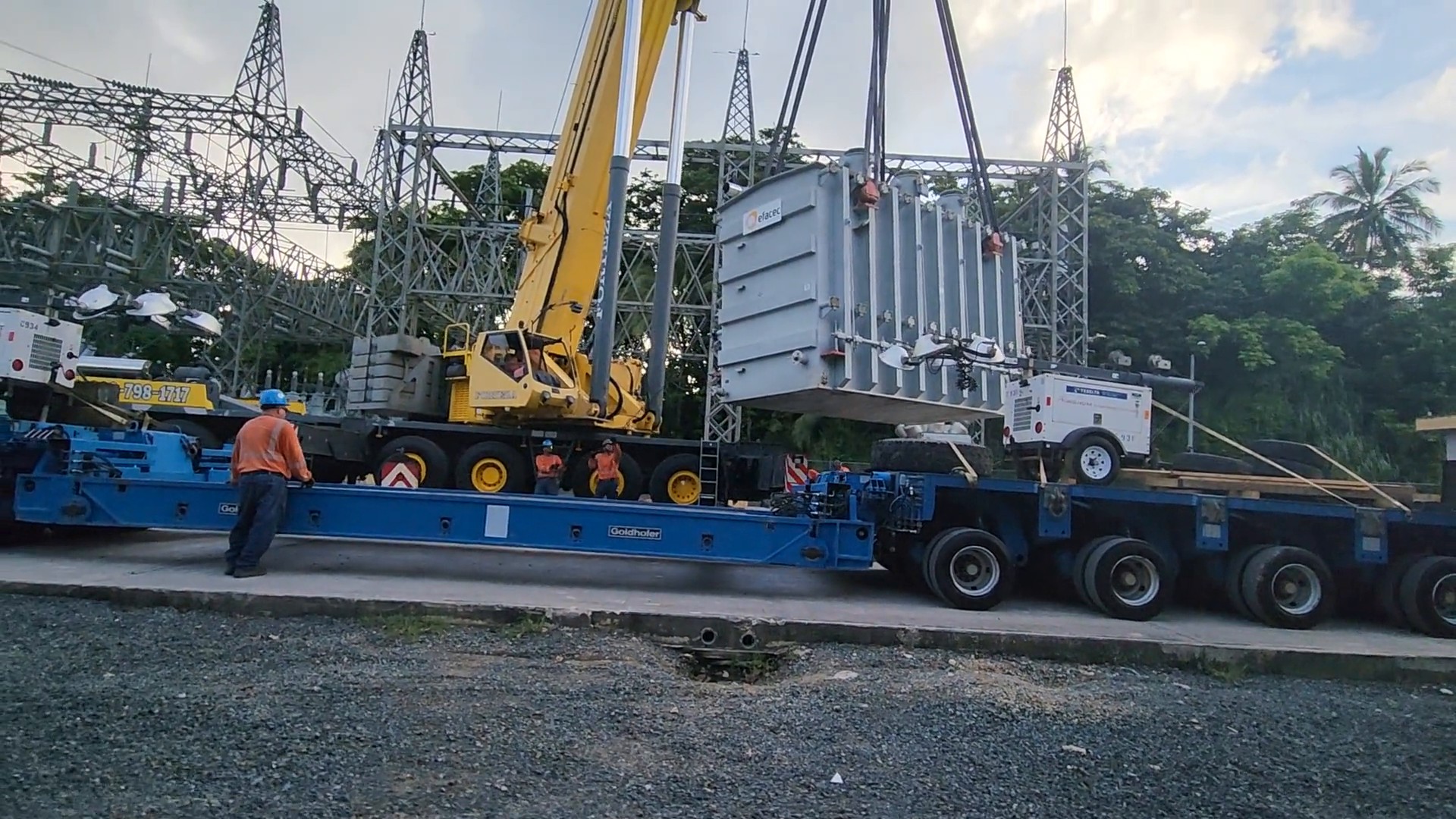
Rigging, lifting and setting
The last hundred feet decide the whole move.
Between the gate and the pad
A heavy piece can cross an ocean without trouble and still be stopped by the last stretch of ground.
The pad may sit inside a fence, under overhead lines, beside a live bay or behind a door no boom can swing through. The soil may not carry an outrigger. The manufacturer allows lifting only from named points, and the outage may allow one attempt. None of that shows on a foundation drawing. It shows when someone stands on the site.
The pad and the ground choose the method
Hydraulic gantry
Four jacking towers on a track lift the piece straight up, the trailer drives out from under it, and the piece comes down on the pad. It works inside a fence, under lines and in bays where a crane has no room.
Jack and slide
The piece is raised in stages on cribbing and slid sideways on tracks. It reaches a foundation the trailer cannot pull up to.
Gantry and slide together
Many sets combine the two. A gantry takes the piece off the trailer, and a jack and slide system walks it onto the foundation.
Crane pick
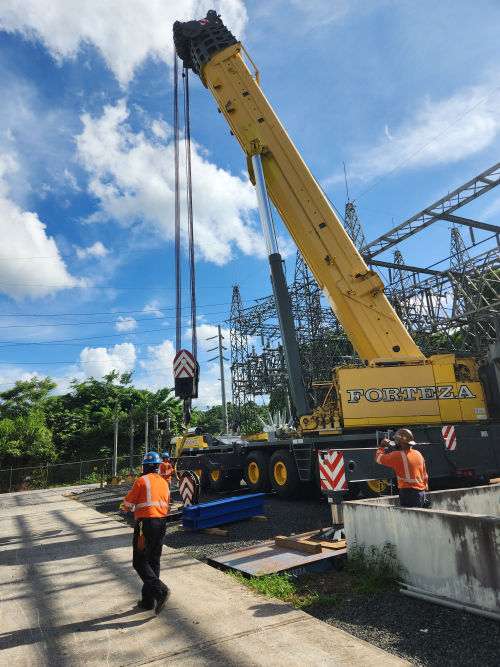
Through crane partners, matched to the weight and the radius. It is the quickest set when the approach is open, the ground is firm and the boom has room to swing.
Off the trailer inside the fence
A gantry set starts before the piece arrives. A crane flies the towers onto their track, the crew levels the track, and the lift is planned against the weight on each tower.
When the piece arrives, the towers take it up together, slowly enough that the operator can read every gauge. The trailer or a self-propelled transporter drives out from under the load, and the piece comes down where it belongs, on its marks.
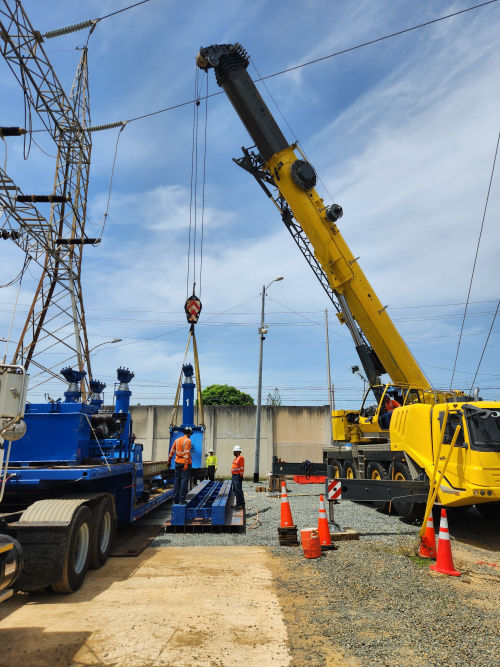
What we read on the site before choosing
Your coordinator walks the route all the way to the pad before the method is settled, and looks at:
- The ground under the crane or the gantry, and where it needs mats or cribbing
- Overhead lines, and the clearance to anything energized
- Gate, fence and door openings on the way to the pad
- The lifting points and rigging instructions from the manufacturer
- Swing room for a boom, and the exclusion zone around the lift
- The height of the foundation against the bed of the trailer
Where the ground or a structure needs a calculation, the engineer is ours or hired locally, depending on the country.
The crane lifts. People land it.
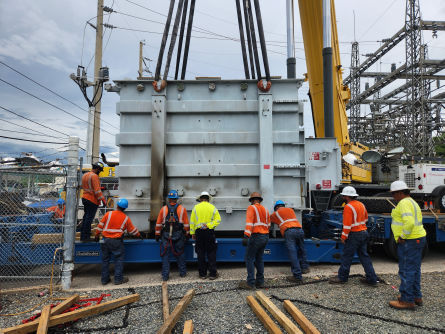
A crane does the lifting, and the landing is done by hand. Tag lines keep the piece from turning, and a signal person talks to the operator. Riggers at each corner bring it down on its marks a fraction of an inch at a time.
Our crews are fluent in English and Spanish, so the signals on the landing can be given in English or Spanish.
When the window is a single night
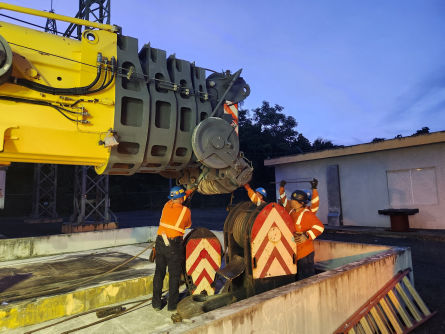
An outage set runs in the hours the operator can release the bay, and those hours are often at night. The lift plan, the lighting and every crew position are fixed before the window opens, because the window does not stretch. A missed hour at the start of the night is an hour the set cannot get back before dawn.
A safety program built for refineries and power plants
We run a behavior-based safety program, held to the highest standard for industrial work in refineries and power plants.
Behavior-based means the program looks at what people actually do on the job, not only at what the paperwork says. Crews watch each other work, talk through what they see, and correct an unsafe habit before it turns into an incident. On a lift, where one wrong step under a suspended load is enough, that habit is the difference.
Setting something like this? Send us the weight, the lifting points and a photo of the pad.
On the day of the set
Can you set a piece where a crane cannot reach the pad?
Yes. A gantry lifts the piece from the trailer and lowers it in place. Jack and slide covers the last stretch without the swing room a crane needs.
What if the ground will not carry the load?
Then the plan changes on paper, not during the lift. Steel mats or cribbing can spread the load. If they are not enough, the ground is prepared first or the method changes.
Whose cranes and gantries are they?
Our equipment partners'. We pick the crane, the gantry or the jacking system for the lift, then plan and run the set.
What do you need from us to plan the set?
The weight of the piece and its lifting points, a drawing of the foundation and photos of the approach from the gate. If there is an outage, tell us when it opens and how long it lasts.
Do you only set, or can you bring the piece as well?
Both. If the piece has not left its origin yet, the haul and the set are planned as one job.
Start with a photo of the pad
A foundation drawing, a few photos of the approach and the weight of the piece are enough to choose a method.